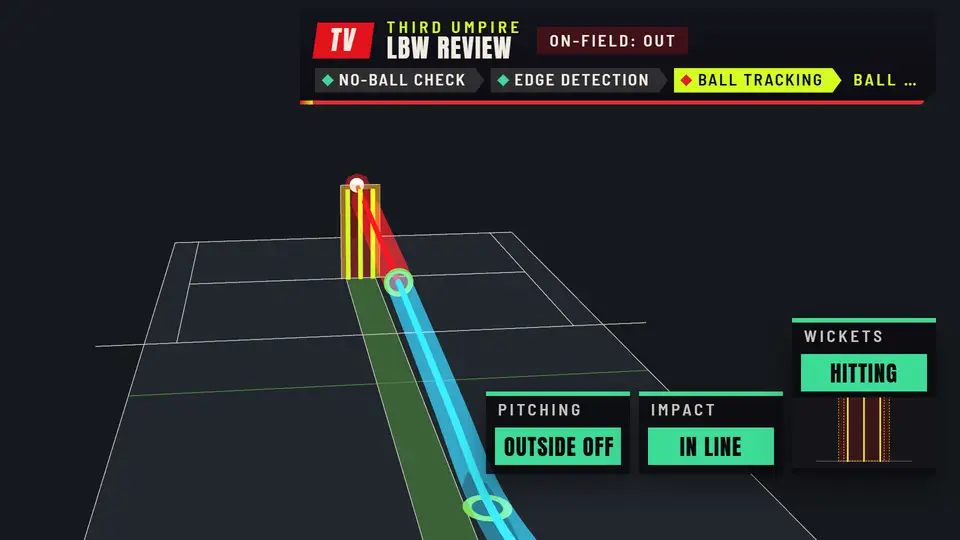
Rebel Cricket League (RCL) has a full Decision Review System. Think you were wrongly given out LBW? Sure the batter nicked it? Send it upstairs. The review plays out like a TV broadcast: a no-ball check, edge detection, thermal imaging and ball tracking, ending with the familiar pitching, impact and wickets verdict.
This page explains exactly how DRS works in the game, checked against version 1.0.0.
What you can review
You can review the two decisions that matter most in real cricket:
- LBW: given out or not out.
- Caught: usually a thin edge to the keeper or slips.
Stumpings and run-outs are not player reviews, because the third umpire checks them automatically with replays, just as on TV. You do not spend anything, and the replay tells the story.
How many reviews you get
| Setting | Reviews per side, per innings |
|---|---|
| Standard matches | 2 |
| Custom formats | 0 to 3 (you choose) |
| Box Cricket | None (and no LBW at all) |
| Online 1v1 | 2, with a 10-second window to decide |
Umpire’s call keeps your review
RCL follows the modern rule. If ball tracking shows the ball clipping the stumps inside the umpire’s-call margin, or the impact is marginal, the on-field decision stands. You keep your review.
If the review overturns the decision, you also keep it. You only lose a review when you were simply wrong. So reviewing a genuine 50-50 costs nothing, and reviewing a plumb LBW out of frustration costs one.
The four steps of a review
Each review plays as a short broadcast sequence. The headings on screen are:
- No-ball check. The front foot is checked first, as on TV.
- Edge detection. An edge trace looks for bat contact. It answers caught-behind appeals, and an inside edge saves an LBW.
- Thermal imaging. A heat view of bat and pad for the closest calls.
- Ball tracking. The predicted path, with three panels: Pitching (in line, outside off, or outside leg), Impact (in line or outside) and Wickets (hitting, missing or umpire’s call).
You can tap Skip step to move on or Skip to decision to jump to the verdict. When umpire’s call saves you, the graphic says so: Review retained.
The +1 review
Burned both reviews on a tight chase? Once per innings you can take a +1 review by watching one optional rewarded ad. It is capped at five a day. RCL Pro players get the +1 without the ad, under the same caps.
It is offered only in casual single-player matches, such as Quick Match and exhibitions. You never see it in a career, a tournament, a challenge, the Daily Heist or online play, where everyone must play on equal terms.
DRS online
Reviews work in live online 1v1 too. You get the same two reviews per innings, with a 10-second decision window so the match keeps moving. Both players see the same review play out, and so do any friends who are watching along.
Why DRS matters in a cricket game
Most mobile cricket games treat the umpire’s finger as final. That works for two-over matches, but in a long chase or a Test match, one bad LBW can decide the game. DRS gives you a decision of your own: when to gamble a review and when to walk.
Of the games we checked, Real Cricket 20’s Google Play listing advertises UltraEdge reviews with Hotspot and Snickometer, and credit to it for that (checked 24 November 2026). In RCL you get the full LBW workflow with umpire’s call in every format from Super Over to Test, offline and online.
Final word
DRS is in every RCL match type except Box Cricket, single-player and online. Rebel Cricket League is free on Android from 1 December 2026. Pre-register on Google Play to be first in line.